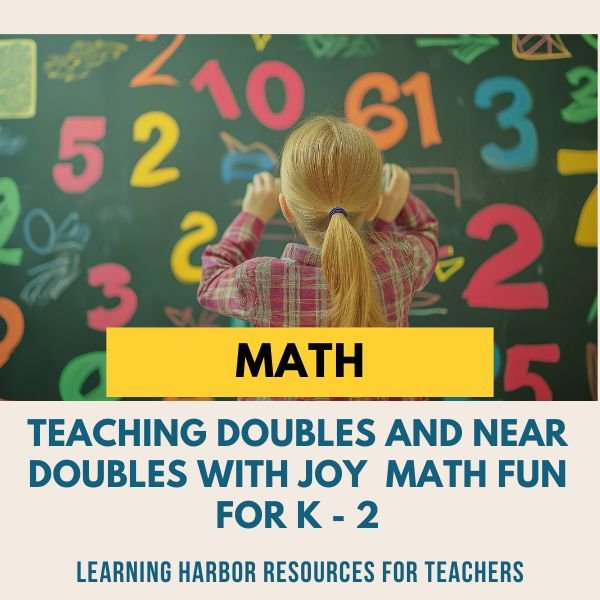

You know those moments when a student’s eyes light up because something finally clicks? Doubles and near doubles do that every time. There’s something about seeing numbers fall into a pattern that just makes sense “If I know 4 + 4, then 4 + 5 is just one more!” Teaching Doubles and Near Doubles are essential for teaching patters.
In my classroom, we work on teaching doubles in all kinds of ways, games, stories, crafts, and a little movement mixed in. The goal isn’t just to memorize facts but to help students understand the relationships behind them. When they get that, fluency follows naturally.
So, grab your dominoes, markers, and maybe a few giggles along the way, here are my favorite ways to make doubles and near doubles come alive.
Strategies for Teaching Doubles and Near Doubles
1. Double It First
Start simple.
I like to hand out number cards (1–10). Students draw one and call out the double “Double 6 is 12!” then write it down.
Next, we take it a step further:
“If double 6 is 12, then 6 + 7 must be 13.”
You can see the wheels turning. It’s that perfect blend of logic and discovery.
2. Domino Doubles
Dominoes make math feel like play. Each child flips one and writes the matching doubles fact. Then we tweak it, add one more dot on a side to explore near doubles.
They love saying, “Look! 3 + 4 is just one more than 3 + 3!”
Music to any math teacher’s ears.
3. Mirror Me Doubles
This one’s always a hit. Hand out mirrors and counters. Students place counters on one side of a mat, then hold up the mirror and suddenly, they see the double reflected back.
There’s a little gasp every time. “It’s double!”
Yes, it is and that moment sticks.
4. Doubles Hopscotch
Math + movement = magic.
Draw a hopscotch grid labeled 1–10. When a student lands on a number, they call it’s double. Then hop one more space for the near double. You’ll hear math facts and laughter all at once, just how it should be.
5. Doubles Detective
This one turns your math block into a mini mystery story.
“Detective Dee loved pairs. One day she found two 5s—they made 10! Then she spotted one more 5 nearby…”
Let students make their own Doubles Detective stories. They’ll practice facts without even realizing they’re doing math work.
6. Sort and Solve
Grab a handful of equations—6 + 6, 7 + 8, 4 + 4, 5 + 6—and have your class sort them into Doubles and Near Doubles piles. It’s quick, visual, and perfect for a math center. They’ll start spotting patterns before you even prompt them.
7. The Doubles Garden
Bring in a little art.
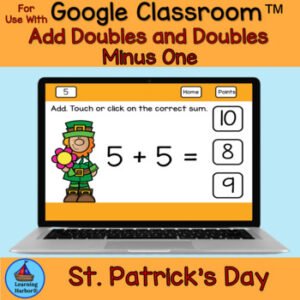
Each flower’s center shows a doubles fact (like 5 + 5 = 10), and the petals show the near doubles (4 + 5 and 5 + 6).
Hang them up for a colorful math display that celebrates both creativity and understanding.
8. Doubles Dash
End your math block with a quick partner challenge.
One student calls a number; the other blurts out the double or near double as fast as possible. Switch and repeat.
Two minutes of energy, laughter, and solid fluency practice.
Why Teaching Doubles Matter
Here’s the thing: doubles and near doubles aren’t just facts. They’re patterns that help kids think like mathematicians. When they start using what they know (like 6 + 6) to figure out something new (like 6 + 7), you know they’re really getting it. And that’s where confidence grows. Be sure to add teaching doubles to your math calendar soon.