

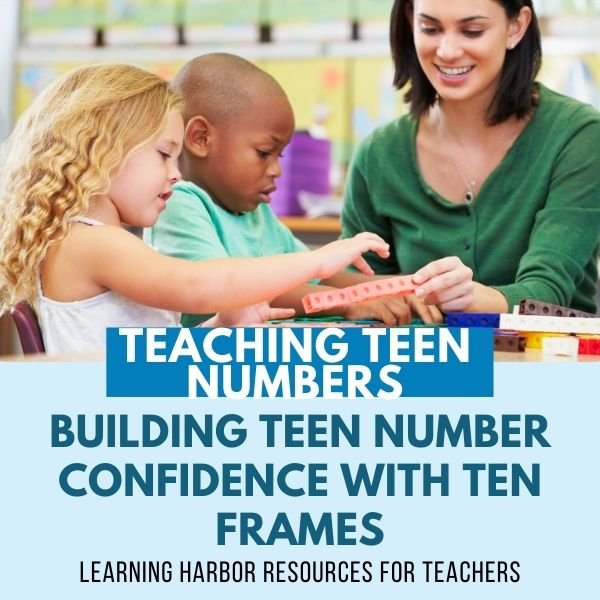

Teaching teen numbers has always been one of those beautiful “bridge moments” in early math. Children move from counting objects one-by-one to understanding how numbers are built, and that shift lays the groundwork for everything that comes later, including place value, regrouping, addition and subtraction. This process is essential for Building Teen Number Confidence and understanding.
One of the most reliable, classroom tested tools for developing number sense is the ten frame. For decades teachers have leaned on ten frames because they help children see numbers in an organized meaningful way. When we pair ten frames with simple hands on manipulatives like dice, cubes or counters, we offer students a tangible concrete experince that make teen numbers feel manageable.
Today we will look at how ten frames can help Kindergarten and First Grade learners build confidence with numbers 11-20 and why this traditional method remains just as effective as ever in Building Teen Number Confidence.
Building Teen Number skills is vital in early education.
Why Teen Numbers Feel Tricky at First
Teen numbers introduce a big idea; numbers are composed of tens and ones. For many young learners “13” doesn’t automatically feel like “10 and 3 more”. Instead it often feels like a brand new item they must memorize. Without visual models it is easy for students to treat each teen number as an isolated fact rather than a part of a larger pattern. That’s where strong number sense comes in. When we help students see how numbers are built, expecially with tools like ten frames, they develop a steady understanding of how quantities relate to each other. This clarity reduces guessing, builds confidence, and prepares students for place value success.
When focusing on Building Teen Number understanding, ten frames serve as a bridge.
Students can gain confidence in Building Teen Number relationships through practice.
Ten Frames: A Classic Tool for Clear Understanding
A ten frame is simple, predictable and comforting for youn learners. It gives children an organized window where they can instantly recognize goups of five and ten. When teaching teen numbers, the ten frame becomes a power bridge from concrete counting to early place value.
You can use single or double ten frames to help students visualize 11-20:
- Eleven shows as a full ten frame pluse one more.
- Fifteen shows a full ten frame plus five more.
- Nineteen shows a full ten frame plus nine more.
This structure helps students internalize the idea: Teen numbers always contain a ten. Instead of “13 is the number after 12”, children begin to think “13 is 10 and 3 more”. This shift is monumental in early number sense.
Building Teen Number understanding helps students progress in math.
Fostering a love for math through Building Teen Number activities is crucial.
By engaging in Building Teen Number activities, students will excel.
Building Teen Number Confidence with Ten Frames
As teachers we know that kids learn best when thir hands are busy and their minds are engaged. Dice pair beautifully with then frames when exploring teen numbers. Rolling dice gives students an element of play and surprise while the ten frame anchors them in structure.
- Roll and Build Teen Numbers
- Students roll two dice (one showing “ten” and the other showing “ones”).
- They fill the ten frame(s) to match their number.
- They read the number aloud using math language like “ten and four more”.
2. Ten Frame Match Up
- Give Students a set of cards showing teen numbers, dice cominations, and double ten frames.
- Students match the numeral to the model.
- This activity builds flexible thinking and strengthens both recognition and understanding.
3. Build, Count and Write
- Using cubes, counters or two color chips student build a teen number on ten frame(s).
- They practice writing the number and the phrase “10 +______ = _______”.
These routines feel familiar and steady and they support the traditional practices we know work well.
Building Teen Number Confidence with Ten Frames Support Number Sense Every Step of the Way
When learners build and rebuild numbers with ten frames and dice, they naturally begin to:
- Recognize teen numbers without counting each dot
- See that numbers can be composed and decomposed
- Understand that ten is a meaningful unit
- Connect physical models to written numerals
- Communicate their thinking using math language
This isn’t just about memorizing 11-20, it’s about helping students own these numbers.
Bring It all Together
Teen numbers are the first big doorway to place value understanding. By using reliable hands on tools, such as ten frames, dice, cubes, and counters, we give students meaningful practice that stands the test of time. This traditional approach honors what has always worked in early math instruction: clear visuals, consistent routines, and concrete experiences. Where you’re teaching in a Kindergarten classroom, guiding small groups in First Grade or supporting young mathematicians in homeschool setting, ten frames provide steady footing. Students feel successful, confident and ready for the next step.
And that is exactly what early math should be.
Effective strategies for Building Teen Number understanding can transform learning.
Building Teen Number confidence leads to greater success in math.
⭐Related Products⭐
❤️ Bunnies and Chicks Eight Games For Teaching Teen Numbers
❤️ Football Fun Teaching Teen Numbers
❤️ Penguins Teen Numbers Tens Blocks and Ten Frames for Google Classroom™
❤️Snowman Teen Numbers Tens Blocks and Ten Frames for Google Classroom™
❤️ Thanksgiving Teen Numbers Tens Blocks and Ten Frames PowerPoint
And we also like:
Teachers play a vital role in Building Teen Number skills through hands-on learning.
Ultimately, Building Teen Number understanding is essential for future learning.