
Have you ever watched your child count on their fingers and wondered “When will they stop doing that?” The answer isn’t more flashcards or rote memorization. The key to unlocking math fluency lies in something called Number Sense. Make Ten with Ten Frames is a fantastic way to learn Basic Math Operations.
Composing and Decomposing Numbers Builds the Foundation for Future Math Skills Make Ten with Ten Frames
Number Sense is simply and intuitive understanding of numbers, how they relate to each other and how they can be move around. It’s the difference between seeing “8+5 and having to count 5 objects, versus knowing you can take 2 from the 5 to “Make a Ten” leaving 3 behind to get 13. The core skill that builds this entire mathematical intuition is Composing and Decomposing numbers up to 10. This simple, playful skill is truly the secret indegredient to your child’s future math success.
Deconstructing the Core Concept: Putting Numbers Together and Taking Them Apart
Composing and Decomposing sound complicate, but they are just fancy terms for parts and wholes. And to break it down even more it is Adding and Subtracting.
Composing (Putting Together)
Composing (Putting Together)
Composing (Adding) is the act of taking two smaller numbers and putting them together to make a larger number (the whole). Math Example: 4 and 6 compose 10.
Decomposing (Breaking Apart)
This the the oposite: taking a whole number and breaking it down into different pairs of parts. Math Example: The number 10 can decompose into 1 and 9, 2 and 8, 3 and 7, and so on.
The Importance of Representation: Seeing Numbers Differently, Make Ten with Ten Frames
If your child can only loot a the numberal 7 and see the symbol, they haven’t achieved full understanding. They must connect that symbol to concrete quantity. This is why it’s vital to practice composing and decomposing using varied representations:
- Concrete Objects/Pictures: (Penguins, cubes, fingers) for hands-on, tangible counting.
- Visual Patterns: (Ten frames, dominos, dice, tally marks) for quick recognition, which educators call subitizing (recognizing quantity without counting).
- Abstract Symbols: (Words and numerals) for formal writing and reading.
When your child knows that 7 penguins + 3 polar bears = 10 and that 7 dots on a ten frame + 3 tally marks=10, they truly understand the concept of ten. Not jus a single picture. This ability to transfer the concept across different visuals is the definition of deep learning.
The Future Payoff: Skills This Builds
Investing time in making ten is the single most valuable step for developing future math skills:
- Mental Math and Flexibility: This practice teaches children to mentally manipulate numbers. When they face a problem like $8 + 5$, they automatically use the “Make a Ten” strategy: $8 + 2$ (from the 5) gives them 10, leaving $3$. So, $10 + 3 = 13$. This is how children move past finger counting and become rapid mental calculators!
- Instant Recall (Addition and Subtraction): If your child knows 6 and 4 go together to make 10, they automatically know that $10 – 4 = 6$ and $10 – 6 = 4$. This builds a complete network of related facts.
- Place Value Mastery: Understanding that the number 13 is composed of 10 and 3 is the absolute bedrock of all multi-digit addition, subtraction, borrowing, and carrying.
Supporting Every Child: Special Populations
The hands on, visual nature of this practice makes it highly beneficial for all learners:
- English Language Learners (ELLs): Using pictures, objects, and sorting games bypasses the language barrier. They can engage with the math concepts directly, even if they are still acquiring the English vocabulary.
- Special Education (SPED) / Neurodivergent: The process is structured, predictable, and highly repetitive, which is essential for encoding skills, building automaticity, and reducing anxiety about new, abstract concepts.
- Gifted Learners: Mastering these combinations early allows them to skip repetitive basic counting and move straight into higher-level mental strategies and complex problem-solving.
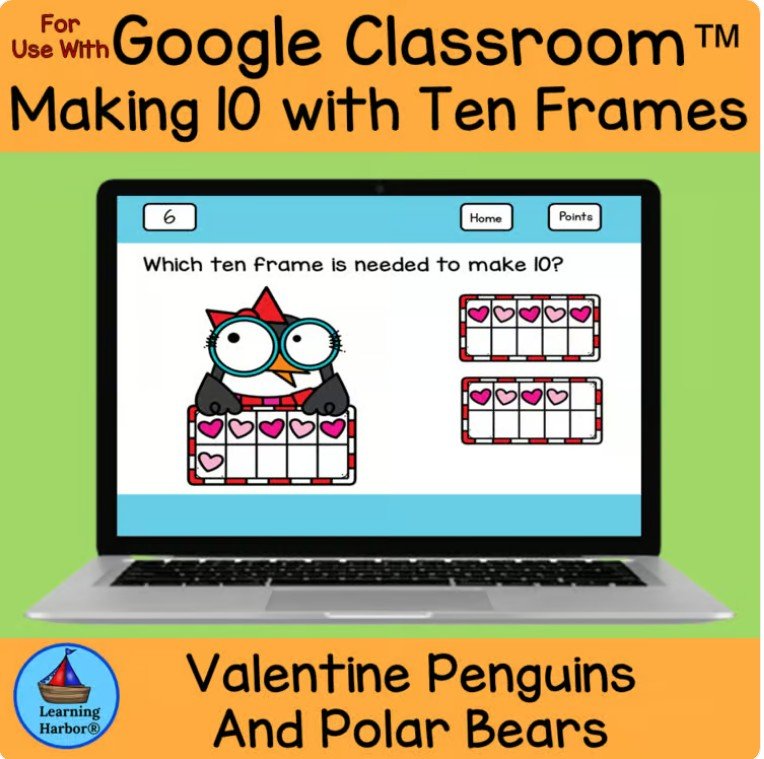
Featured Resource: Making Ten with Penguins and Polar Bears:
Ready to turn this foundational skill into a fun activity? We recommend Making 10 with Ten Frames with Valentine Penguines and Polar Bears